Today I've started a discussion with four people who study media about books.
First I asked them what they thought what a book was, according to them a book was the following:
- a way to travel through time
- a book has a fixed beginning and end
- a book always has a cover, also digitally (one part where you don't put information in except for title, publisher, illustrator and writer)
- a book is a good tool to fix a wobbly chair
- a book has a certain order information is told and this is determined by the creator
Then I asked them how a book is different from an animationfilm, because a lot of descriptions they gave fit other media as well.
- a book is stationary
- a book is physical, you can feel and smell it
- a book is pile-up of a lot of ideas
- a book leaves a lot for own interpretation, you can use your own imagination to picture a story
- a book is a document
- a book is divided into chapters, and every chapter has a beginning and an end
So then I asked them if an E-book is a book as well. The opinions about this were divided;
- Meaby, An E-book is derived from a book
- No, you can't hold and touch an E-book
- No, an E-book misses clarity, you can't flip through pages easely
- Yes, an E-book is a metaphor of a book
- No, you call it an E-book because it's not a book, E-mail is not mail either.
Then the discussion really started, people came with a lot of ideas:
- Choose your own adventure books (analogue interactive story)
- A big page of text is not a book, it's a story.
- So pages and chapters make a book.
- An interactive book should have elements of an analogue book
- Or you should leave it (the naming of what you're making) open and create a new media.
- The added value of a book is that it's tangible
- You can collect books
- We like to collect because that way we create a picture of ourselves, an identity
- Symbolic value that can't be simulated digitally, because digital = easy to reproduce
- A book can feel a certain way (size, paper, cover, etc.)
- People really sit down and take the time to read a book (rest), on the computer or Ipad their attention span is much shorter (active).
- For a game you can also really sit down and play for hours. - so you settle yourself to get in a gaming or reading mood
- A book askes for attention and a passive mood.
- Fewer and fewer elements in our life are done physically.
- In both a book as a game you can determine your own tempo
- Maybe you could work in layers, with immersion. The tempo of the story (or other elements) adapt to your tempo.

Posts tonen met het label books. Alle posts tonen
Posts tonen met het label books. Alle posts tonen
woensdag 22 februari 2012

dinsdag 31 januari 2012
De Slegte: Interactive Books - digital and analog
I've been to 'De Slegte', a big book store in The Hague, where they have over 3000 different books, and a lot of second hand books.
I wanted to look at 'analog interactive books', what sort of interactions do they facilitate and which of these can you find back in 'digital interactive books'.
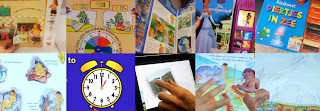
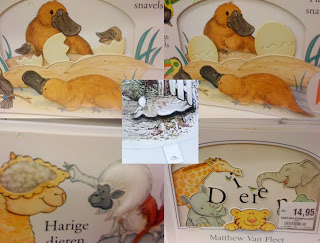
This book had nice pull and push cards to create some sort of animation or change in the picture. It also contains furry fabrics that are excellent for sensory play, but which is hard/impossible to create digitally.
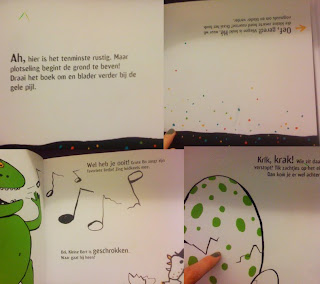
This book does it more the other way around. It is an analog book, but it 'suggest' that is is interactive in a creative way that would be better suited for digital media. That makes it fun.
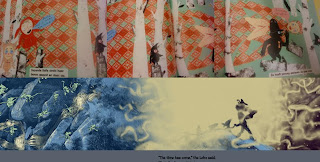
I love both of these, the one above is a book, where they really played with size. The other one I will tell you about in a few seconds.
I've also looked at other media than Interactive Books for the Ipad and online, I wanted to find examples of storytelling that are not referred as as 'interactive books'. These kind of examples could be a good inspiration for my project.
Hobolobo Some sort of webcomic. I just LOVE the way you can scroll through the story. The story is divided into chapters and every chapter is one long page with nice illustations which you can scroll through, text appears ad some points (so it's not always part of the illustration) and the perspective scrolls with you (like in the student game Hollandia). After you read through the chapter, you can click on the next one. In chapter 3, music also starts, in the beginning it's not that loud. But you're actually scrolling towards a point where the music comes from. Also images and animations appear sometimes, which really create a mood.
I think this is one of my favourite examples so far, I just love to play with this 'webcomic'. It is so much fun to scroll though the page, see how perspective reacts on me. I actually already had some ideas that are really comparable to this way of interacting.
Only thing I have trouble with, is the way you can navigate through chapters, I can only go to the next one, while sometimes I want to skip directly to, for instance, the 7th chapter.
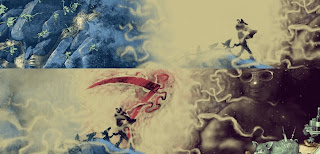
PID I'm very inspired by the lightning of this game. Maybe we can use some way of interacting with lights. Or something else. But I do think it's important that there is some 'thin red line' in the form of an interaction that is continius through the story. In games you've also got your 'standard' game play, for instance shooting. And I think in that way a game gets more 'one'. What I see in a lot of Interactive Books is that every page has it's own interaction. Which is okay, but it can be distracting to a story if you have to practise a new interaction every page... I have to test this.
Discovery This game has a fun feature. The story tells you what you need to do, by doing this, the story adjust and continues. It is done very simplistic, but it is a good example of how to create gameplay out of narrativity (or the other way around), it's logical.
I wanted to look at 'analog interactive books', what sort of interactions do they facilitate and which of these can you find back in 'digital interactive books'.


This book had nice pull and push cards to create some sort of animation or change in the picture. It also contains furry fabrics that are excellent for sensory play, but which is hard/impossible to create digitally.

This book does it more the other way around. It is an analog book, but it 'suggest' that is is interactive in a creative way that would be better suited for digital media. That makes it fun.

I love both of these, the one above is a book, where they really played with size. The other one I will tell you about in a few seconds.
I've also looked at other media than Interactive Books for the Ipad and online, I wanted to find examples of storytelling that are not referred as as 'interactive books'. These kind of examples could be a good inspiration for my project.
Hobolobo Some sort of webcomic. I just LOVE the way you can scroll through the story. The story is divided into chapters and every chapter is one long page with nice illustations which you can scroll through, text appears ad some points (so it's not always part of the illustration) and the perspective scrolls with you (like in the student game Hollandia). After you read through the chapter, you can click on the next one. In chapter 3, music also starts, in the beginning it's not that loud. But you're actually scrolling towards a point where the music comes from. Also images and animations appear sometimes, which really create a mood.
I think this is one of my favourite examples so far, I just love to play with this 'webcomic'. It is so much fun to scroll though the page, see how perspective reacts on me. I actually already had some ideas that are really comparable to this way of interacting.
Only thing I have trouble with, is the way you can navigate through chapters, I can only go to the next one, while sometimes I want to skip directly to, for instance, the 7th chapter.

PID I'm very inspired by the lightning of this game. Maybe we can use some way of interacting with lights. Or something else. But I do think it's important that there is some 'thin red line' in the form of an interaction that is continius through the story. In games you've also got your 'standard' game play, for instance shooting. And I think in that way a game gets more 'one'. What I see in a lot of Interactive Books is that every page has it's own interaction. Which is okay, but it can be distracting to a story if you have to practise a new interaction every page... I have to test this.
Discovery This game has a fun feature. The story tells you what you need to do, by doing this, the story adjust and continues. It is done very simplistic, but it is a good example of how to create gameplay out of narrativity (or the other way around), it's logical.
Abonneren op:
Posts (Atom)